Raphaël Bassan. The Filmmaking Critic
Including 3 films directed by Raphaël Bassan plus 2 bonus films directed by Michel Amarger & Frédérique Devaux and Viviane Vagh.
With a 43p. bilingual booklet in English & French.
Including 3 films directed by Raphaël Bassan plus 2 bonus films directed by Michel Amarger & Frédérique Devaux and Viviane Vagh.
With a 43p. bilingual booklet in English & French.
Edición bilingüe en castellano e inglés / English and Spanish bilingual edition
ÍNDICE / INDEX
INTRODUCCIÓN
Una gota de agua pura basta para purificar un océano; una gota de agua impura basta para manchar un universo / Francisco Algarín Navarro
ENTREVISTA CON JEANNETTE MUÑOZ
Las piedras pueden ser pan y la arena azúcar / Vanessa Agudo Molina, Francisco Algarín Navarro, Blanca García
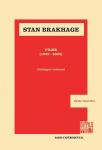
DVD/Blu-Ray combo with the film 'Anticipation of the Night' by Stan Brakhage
“The great achievement of Anticipation of the Night is the distillation of an intense and complex interior crisis into an orchestration of sights and associa- tions which cohere in a new formal rhetoric of camera movement and montage.” -P. Adams Sitney
Ism, Ism, Ism / Ismo, Ismo, Ismo is the first comprehensive, United States–based film program and catalogue to treat the full breadth of Latin America’s vibrant experimental film production. The exhibition features key historical and contemporary films from Argentina, Brazil, Bolivia, Chile, Colombia, Cuba, Ecuador, Mexico, Paraguay, Peru, Uruguay, Venezuela, Puerto Rico and the United States.
Done with Filming is the title of a film made by Maurice Lemaître between 1985 – 1990. It is composed of a collection of slides, primarily from New Wave films, on which the artist has intervened in multiple ways: with touch-ups, smudges, and graphic and visual interventions. Simultaneously, the soundtrack consists of a fake journalistic-style interview in which Lemaître, in his characteristic manner that is both serious and humorous, gives an account of his relationship with cinema, criticism, and creation.
Movement as Meaning in Experimental Cinema offers sweeping and cogent arguments as to why analytic philosophers should take experimental cinema seriously as a medium for illuminating mechanisms of meaning in language. Using the analogy of the movie projector, Barnett deconstructs all communication acts into functions of interval, repetition and context. He describes how Wittgenstein's concepts of family resemblance and language games provide a dynamic perspective on the analysis of acts of reference.
Imagine an eye unruled by man-made laws of perspective, an eye unprejudiced by compositional logic, an eye which does not respond to the name of everything but which must know each object encountered in life through an adventure of perception. How many colors are there in a field of grass to the crawling baby unaware of "Green"? How many rainbows can light create for the untutored eye? How aware of variations in heat waves can that eye be? Imagine a world alive with incomprehensible objects and shimmering with an endless variety of movement and innumerable gradations of color.
The 1970s was an enormously creative period for experimental film. Its innovations and debates have had far-reaching and long-lasting influence, with a resurgence of interest in the decade revealed by new gallery events, film screenings and social networks that recognise its achievements. Professor Laura Mulvey, and writer/director Sue Clayton, bring together journalists and scholars at the cutting edge of research into 1970s radical cinema for this collection.
Slow Writing is a collection of articles by Thom Andersen that reflect on the avant-garde, Hollywood feature films, and contemporary cinema. His critiques of artists and filmmakers as diverse as Yasujirō Ozu, Nicholas Ray, Andy Warhol, and Christian Marclay locate their work within the broader spheres of popular culture, politics, history, architecture, and the urban landscape. The city of Los Angeles and its relationship to film is a recurrent theme.
Art theory has always had a major component in writing, or the illustration of the artists’ own ideas around their trajectory and working methods. To be more specific, writing has been a way for artists to ponder on their own activity, to identify certain trends they felt close to, to articulate a reflection on a given medium and challenge preconceived ideas.
|
Esta página web no es una tienda. Las publicaciones aquí listadas lo son únicamente para información y referencia. Cuando la publicación sea de distribución limitada se incluirán enlaces a puntos de venta. |