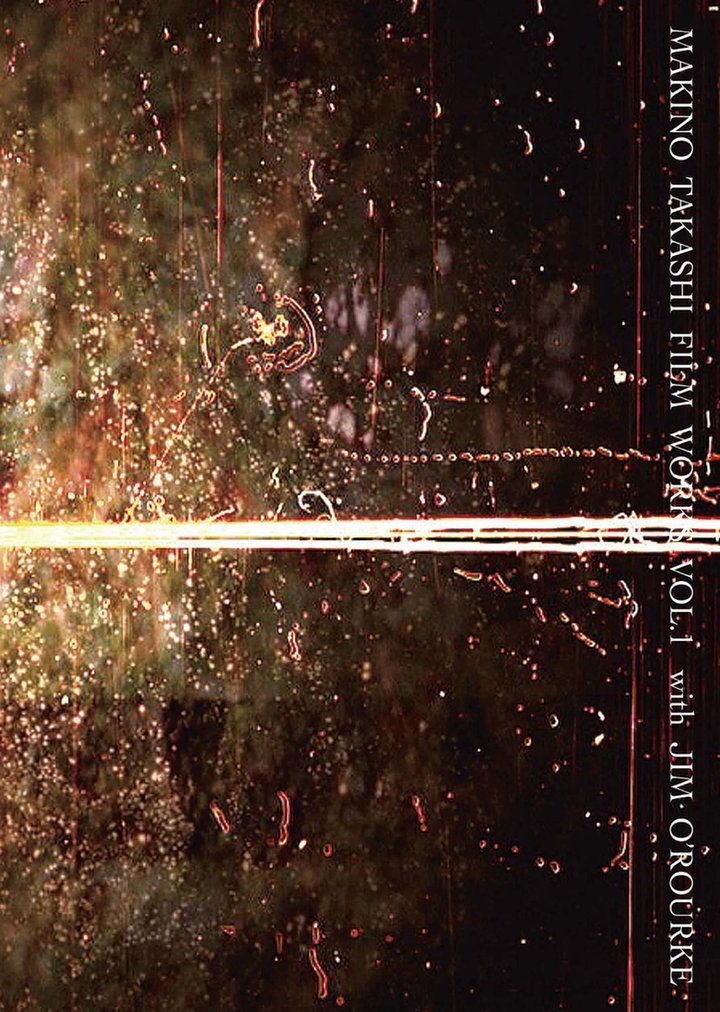
Makino Takashi Film Works vol.1 with Jim O'Rourke
Includes the works "No is E," "Elements of Nothing," "The Seasons," "still in cosmos," "WORLD"
Antoni Padrós is a singular figure of Catalan Cinema. Coming from painting, his creative freedom practiced during Franco's regime placed him on the margins of cinema. His films tie in with the American underground and European militant cinemas. The author, however, did not abandon his sniper and transgressive position once democracy was established, maintaining his independent creative proposal. From the margins of the film industry, his work has taken on a progressive role and today is recognized by museums, due to its creative ability through dialogue with the Arts. This edition aims to contribute to the discovery and recovery of the unclassifiable, experimental and vital work of Antoni Padrós.
In a career that spanned five decades, most of them spent in San Francisco, Bruce Conner (1933–2008) produced a unique body of work that refused to be contained by medium or style. Whether making found-footage films, hallucinatory ink-blot graphics, enigmatic collages, or assemblages from castoffs, Conner took up genres as quickly as he abandoned them. His movements within San Francisco’s counter-cultural scenes were similarly free-wheeling; at home in beat poetry, punk music, and underground film circles, he never completely belonged to any of them. Bruce Conner belonged to Bruce Conner. Twice he announced his own death; during the last years of his life he produced a series of pseudonymous works after announcing his “retirement.” In this first book-length study of Conner’s enormously influential but insufficiently understood career, Kevin Hatch explores Conner’s work as well as his position on the geographical, cultural, and critical margins.
Andy Warhol was a remarkably prolific filmmaker, creating more than 100 movies and nearly 500 of the film portraits known as Screen Tests. And yet relatively little has been written about this body of work. Warhol withdrew his films from circulation in the early 1970s and it was only after his death in 1987 that they began to be restored and shown again. With “Our Kind of Movie” Douglas Crimp offers the first single-authored book about the full range of Andy Warhol’s films in forty years--and the first since the films were put back into circulation.
Francisca Benitez’s Preemptive Disappearance, describes the effects of the Patriot Act on artists living in New York as told through the tender recounting of someone who discovers, when returning home one day, that her husband has been arrested for taking photographs ‘in the wrong place’.
Sabine Folie and Susanne Titz, edited for the Generali Foundation, Vienna and Museum Abteiberg, Mönchengladbach 2012.
With introductions by Sabine Folie and Susanne Titz
Rewind: Artists video in the 70s and 80s derives from a four-year research project into the history of an art form that has become the hallmark of contemporary art. Based on an archive of interviews, ephemera and archive copies of tapes and installations from the pioneering period of British video art, this anthology brings together some of the leading scholars in the field, backed by an expert panel, to lay the groundwork for a history of the people, activities, institutions and interventions that made of video art the one true avant-garde in the United Kingdom in the 20th century. Rewind is the founding text for the history of British video art; draws on a unique archive of oral history and personal experience; and opens up the archive for contemporary artists, curators, media historians and archivists.
The story of my hair can be told in two lines. My hair was long and black. It has turned white. It hasn't been cut since 1982, almost thirty years ago. Story of my Hair is a journey, both in space and in time. Anyone looking for truths, whether geographical, scientific or historical, will be disappointed. After looking at real events and real places the film very soon distances itself from them, preferring poetry and fiction. In his own fashion the auteur has combined the story of Samson and Delilah, the journey of those condemned to the death camps, the science of hair and a few thoughts about the meaning and fragility of life.
The Flicker sweeps away reality, transports us into another environment and acts as a sort of instrument of perceptual experimentation. The filmmaker himself considers it as a kind of science fiction film which, instead of entering us into strange worlds – which have everything to do with this world and the development of conventional narrative structures –, proposes to transport us into a totally different dimension which is abstract and structured in a manner radically different from our environment.
|
Please notice that our website is not a shop. The items listed here are just for reference. Links will be provided when the publication is not generally available via standard retailers. |